

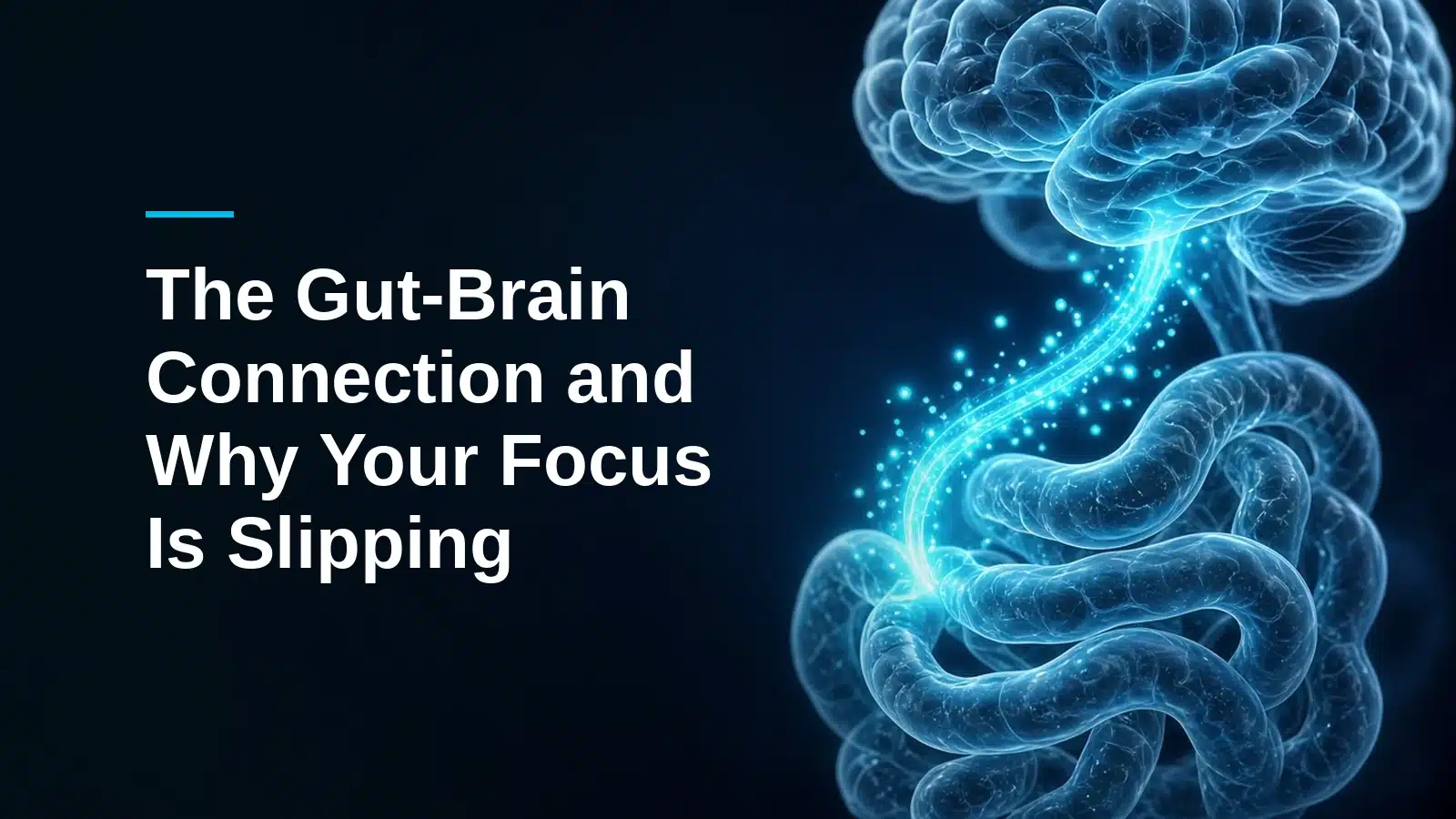
If you’re rereading emails, losing your train of thought in meetings, and leaning on more coffee to get through the afternoon, and you’ve also noticed bloating, irregular digestion, or a stomach that reacts to foods it used to handle, those may not be separate problems.
Most people don’t connect them. Your gut and brain are in constant communication, and when one is under strain, the other often feels it.
That doesn’t mean every case of brain fog starts in the gut. It means the gut belongs on the list of things to check. Here is how the connection works, what the evidence does and doesn’t show, and where testing fits.
How the Gut and Brain Talk to Each Other
Researchers call this two-way connection the microbiota-gut-brain axis. A major 2019 review in Physiological Reviews describes several routes of communication: the immune system, the vagus nerve, the gut’s own nervous system, tryptophan metabolism, and compounds produced by gut microbes, such as short-chain fatty acids (Cryan and colleagues, 2019).
A few of those routes are worth understanding.
The vagus nerve. This nerve connects the brain with the gut and other organs, and much of its traffic runs upward, carrying information about the state of the gut to the brain (Breit and colleagues, 2018).
The immune system. The gut-associated lymphoid tissue makes up almost 70% of the body’s entire immune system (Vighi and colleagues, 2008). When the gut is inflamed, immune signals don’t stay local.
The enteric nervous system. The gut has its own extensive network of neurons that controls digestion and communicates with the brain. It’s often called the “second brain.”
The Serotonin Detail Most Articles Get Wrong
You may have read that most of your serotonin is made in the gut. That’s true. Gut microbes help regulate serotonin production by specialized cells in the gut lining (Yano and colleagues, Cell, 2015).
The part often left out: serotonin made in the gut acts mainly in the gut and bloodstream, where it affects digestion and platelets. The brain makes its own. So the gut’s influence on mood and focus runs mainly through nerves, immune signals, and microbial compounds, not by shipping serotonin to the brain.
How Stress Reaches the Gut
The connection runs both ways, and stress is one of the clearest examples.
In a study of healthy volunteers, a stressful public-speaking task increased small intestinal permeability, but only in people whose cortisol rose in response (Vanuytsel and colleagues, Gut, 2014). Increased permeability, often called “leaky gut,” can let bacterial products cross the gut lining and trigger immune activity.
That’s one reason sustained stress and gut symptoms so often show up together. If your cortisol rhythm is off, your gut may be paying for it. We cover that measurement in Why Your Cortisol Rhythm Matters More Than a One-Time Stress Test.
What the Evidence Shows About Brain Fog
Here is where care matters. Research has linked changes in the gut microbiome to anxiety, depression, and conditions affecting the brain and nervous system. Much of the strongest mechanistic evidence comes from animal studies, and human research is still developing. The Physiological Reviews authors describe translational human studies as ongoing.
So the fair summary is this: the gut is a plausible contributor to poor focus and low mood in some people, especially when gut symptoms, inflammation, or stress are also present. It’s rarely the only factor. Sleep, blood sugar, thyroid function, hormones, and stress load can all produce the same fog.
The Gut and Your Thyroid
One connection worth knowing: celiac disease is more common in people with autoimmune thyroid disease, affecting about 1 in 62 in one large analysis (Roy and colleagues, Thyroid, 2016). Low thyroid function can also slow gut motility.
Since thyroid problems are a common cause of slowed thinking, it’s worth looking at both together. See Thyroid Testing Beyond TSH for which thyroid markers to check.
Where Stool Testing Fits
When gut symptoms and focus problems appear together, I often want a closer look at the gut itself.
One tool is the GI-MAP, a stool test that uses DNA-based (qPCR) methods to measure bacteria, parasites, fungi, and H. pylori, plus markers of digestion, inflammation, and gut immune function, such as calprotectin and secretory IgA.
A stool test can show things that symptoms alone can’t, such as an infection, an overgrowth, poor digestion, or inflammation that deserves attention. But it’s one input, not a diagnosis by itself and not a cure. Results need to be read alongside your history, symptoms, and other labs. Not everyone with brain fog needs one.
What Supports a Healthier Gut-Brain Axis
The foundations are well established, and most of them help focus directly as well:
- Eat a wide range of plants and fiber. Fiber feeds the microbes that produce short-chain fatty acids.
- Include fermented foods. In a 17-week randomized study, a diet high in fermented foods increased microbiome diversity and lowered inflammatory markers (Wastyk and colleagues, Cell, 2021). The study was small, so treat it as a useful signal rather than the final word.
- Protect sleep. Poor sleep affects the gut, the immune system, and focus.
- Manage stress load, not just with willpower but with practices that change physiology.
- Move regularly, with both cardio and strength training.
- Limit alcohol and unnecessary antibiotics, both of which can disrupt the microbiome.
When testing finds a specific problem, such as an infection or inflammation, targeted treatment comes next. Probiotics can help in some situations, but effects are strain-specific, and more isn’t automatically better.
How We Approach Gut Health at Peak Launch
At Peak Launch, gut health is part of a comprehensive workup in our Precision Performance Medicine model. We follow Test. Design. Track. We test where it’s warranted, including stool testing, alongside thyroid, hormones, metabolic markers, and inflammation. We design a plan around what’s actually driving your symptoms, and we track the changes, in your labs and in how you feel, in PLX. We work with leaders virtually nationwide.
The goal is concrete: clearer thinking, steadier energy, and digestion that stops being a daily distraction.
Frequently Asked Questions
Can Gut Problems Cause Brain Fog?
They can contribute. The gut and brain communicate through nerves, immune signals, and microbial compounds. Gut issues are rarely the only cause, so sleep, thyroid, blood sugar, and stress should be evaluated too.
What Is the Gut-Brain Axis?
It’s the two-way communication system linking the gut and brain through the vagus nerve, the immune system, the gut’s own nervous system, and compounds produced by gut microbes.
Should I Get a GI-MAP Test?
It can be useful when gut symptoms appear alongside fatigue or focus problems. It’s one tool, and results need to be interpreted by a physician in the context of your full picture.
Do Probiotics Improve Focus?
The evidence is mixed and strain-specific. Diet, sleep, and stress management usually come first.
How Long Does It Take to Improve Gut Health?
It varies. Diet changes can shift the microbiome within weeks, but meaningful symptom changes often take longer, especially when there’s an underlying problem to treat.
Ready to Get Started?
Stop Guessing. Start Getting Answers.
If your focus has slipped and your gut hasn’t felt right either, a Strategy Call is where we see whether a full workup is the right fit for you.
Medically reviewed by Tracy Gapin, MD

